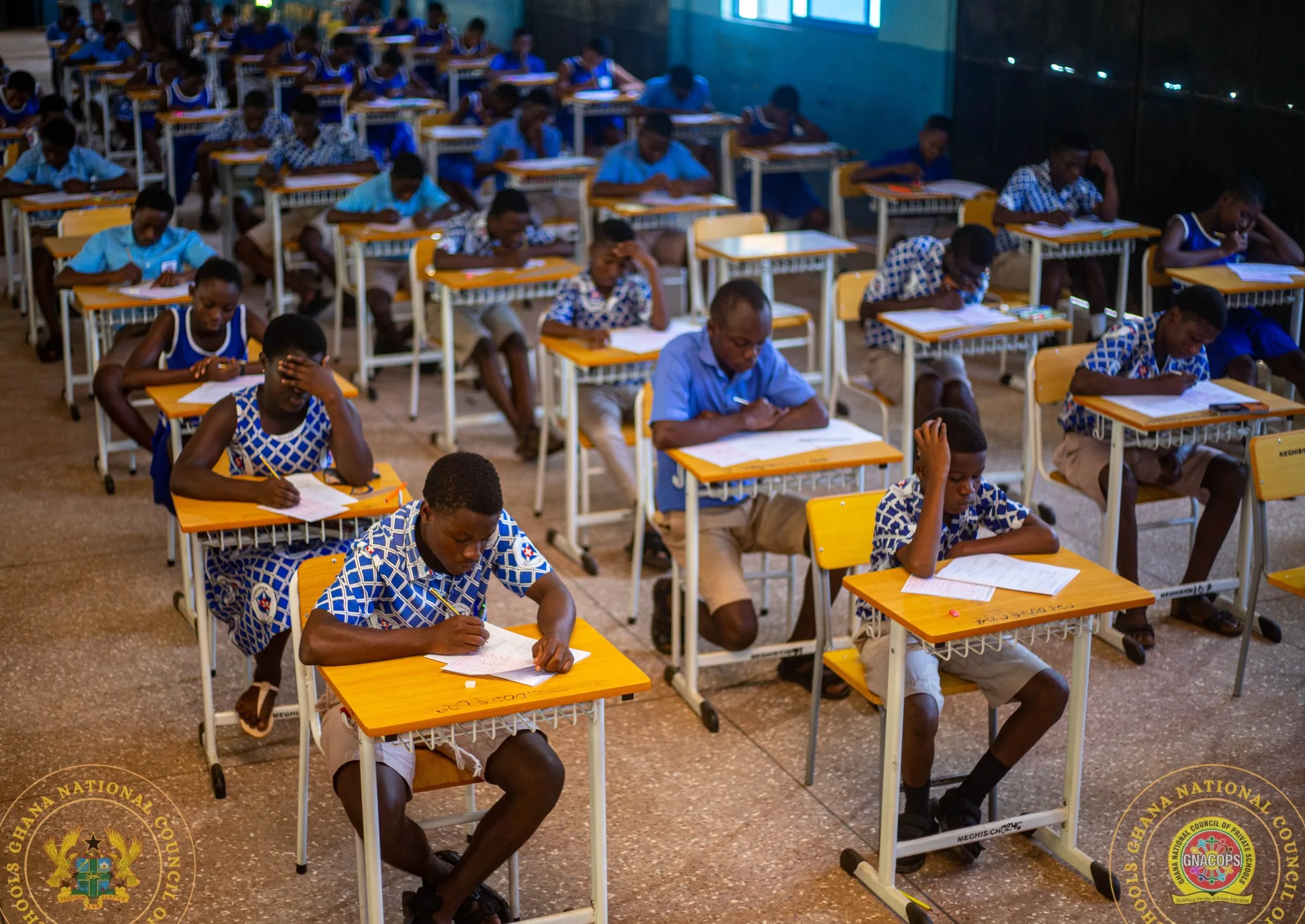

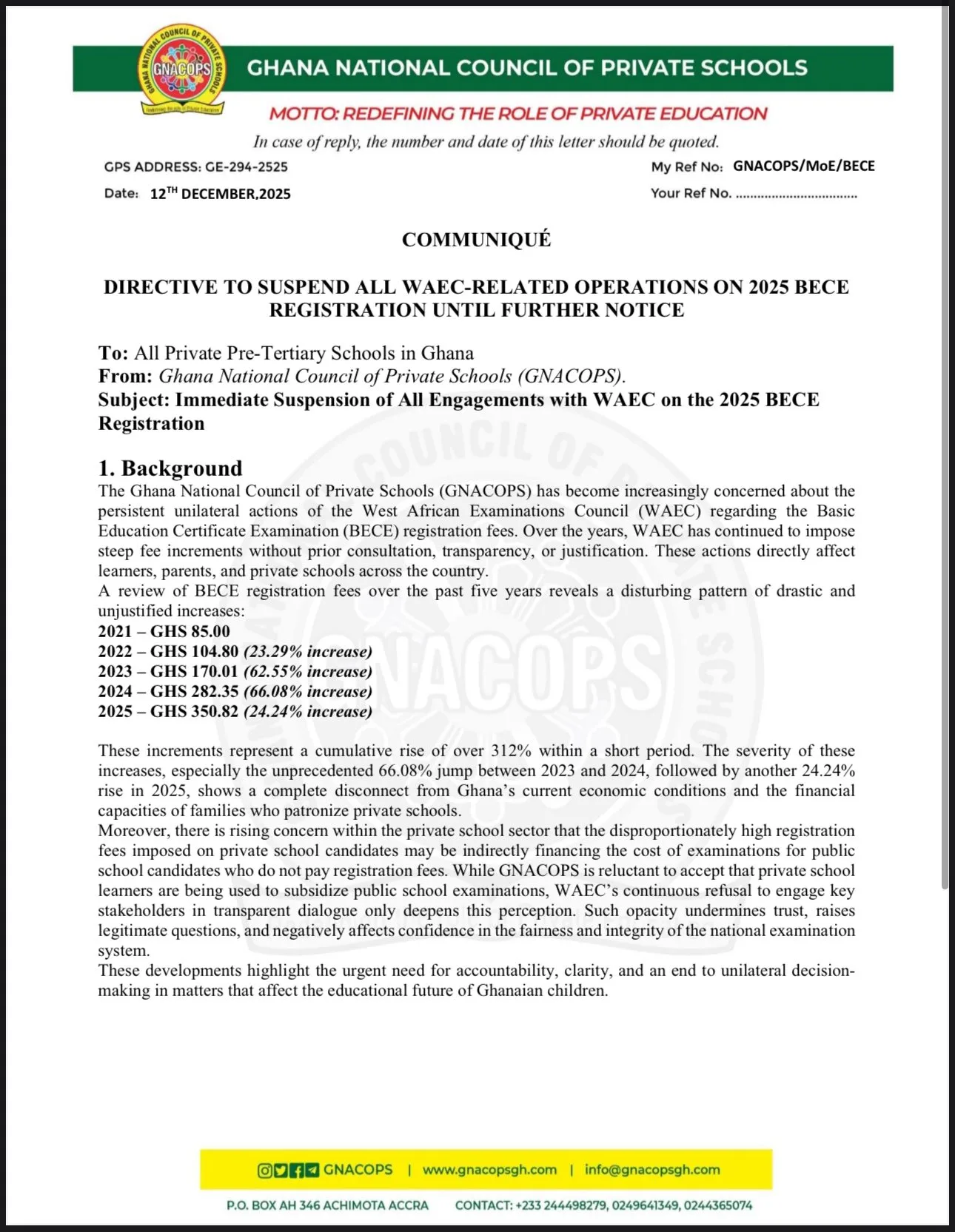
The Ghana National Council of Private Schools (GNACOPS) has issued a strong directive that is sending ripples across the country’s education sector. In a communiqué dated 12th December 2025, the Council ordered all private pre-tertiary schools in Ghana to immediately suspend every WAEC-related engagement tied to the 2025 BECE registration—and to maintain this suspension until further notice.
This unprecedented move stems from growing concerns about steep fee increments, lack of transparency, and exclusion of private stakeholders from major decisions affecting national examinations. Below is a breakdown of what led to this major directive and what it means for learners, parents, and school administrators.
Why GNACOPS Issued the Directive
GNACOPS expressed deep worry over what it describes as persistent unilateral actions by WAEC, especially concerning the continuous rise in BECE registration fees without proper justification.
A five-year review of BECE registration fees revealed dramatic increases:
- 2021 – GHS 85.00
- 2022 – GHS 104.80 (23.29% increase)
- 2023 – GHS 170.01 (62.55% increase)
- 2024 – GHS 282.35 (66.08% increase)
- 2025 – GHS 350.82 (24.24% increase)
These increments amount to over 312% growth within just a few years. GNACOPS argues that these steep hikes do not reflect current national economic realities and place an unsustainable burden on parents whose children attend private schools.
The Council also highlighted a growing suspicion within the private sector: that fees paid by private school candidates may be used to subsidize public school examinations—a claim they insist must be clarified with full transparency.
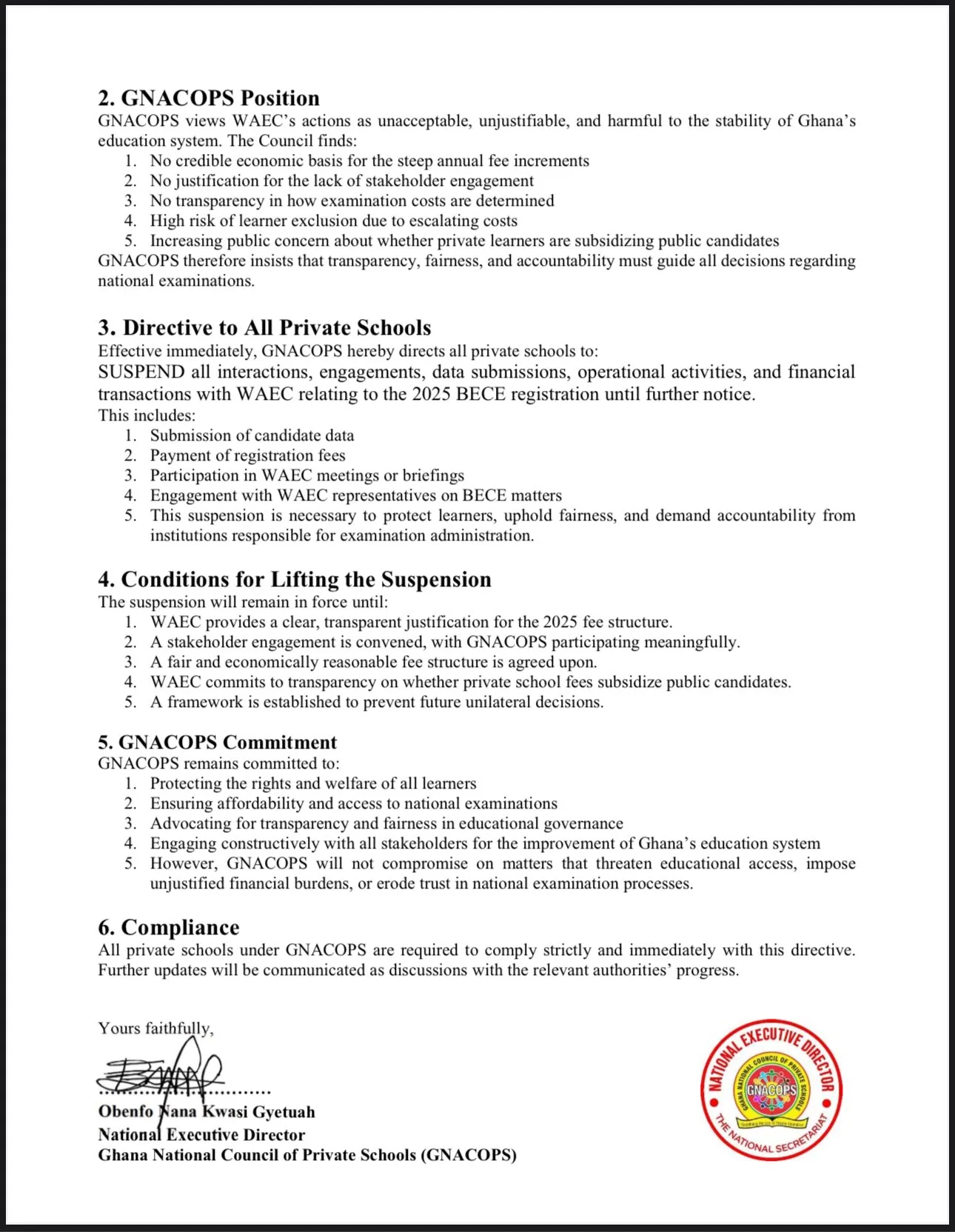
GNACOPS’ Position on WAEC’s Actions
GNACOPS categorically described WAEC’s conduct as “unacceptable, unjustifiable, and harmful” to Ghana’s education system. According to the Council, WAEC has:
- Offered no credible economic basis for the fee hikes
- Failed to engage key stakeholders, including private schools
- Not shown transparency in how examination costs are determined
- Created conditions that may exclude learners who cannot afford the rising fees
- Not addressed the concerns about private fees potentially subsidizing public candidates
Given these concerns, GNACOPS insists that fairness, accountability, and transparency must guide all decisions relating to national examinations.
Directive to All Private Schools
Effective immediately, all private schools under GNACOPS have been instructed to suspend every form of interaction with WAEC relating to the 2025 BECE. This suspension covers:
- Submission of candidate data
- Payment of registration fees
- Participation in WAEC meetings
- Engagement with WAEC officials on anything related to BECE
GNACOPS emphasizes that this action is necessary to protect learners and demand accountability from WAEC.
Conditions for Lifting the Suspension
According to the communiqué, the suspension will only be lifted when WAEC:
- Provides a clear and transparent justification for the 2025 fee structure
- Convenes a stakeholder engagement with meaningful GNACOPS participation
- Agrees on a fair and economically reasonable fee structure
- Clarifies whether private school fees subsidize public candidates
- Establishes a framework to prevent future unilateral fee decisions
Until these conditions are met, private schools are expected to comply fully with the suspension.
GNACOPS’ Commitment Moving Forward
GNACOPS reaffirmed its dedication to:
- Protecting learners’ welfare
- Ensuring access and affordability to national examinations
- Advocating for transparency in educational governance
- Engaging stakeholders to improve Ghana’s education sector
However, the Council stressed it will not compromise on issues that affect equitable access to education or erode trust in national examination processes.
What This Means for Parents and Students
For now, the registration of private school candidates for the 2025 BECE is on hold nationwide. Parents and students may experience uncertainty in the coming weeks, but GNACOPS assures that updates will be provided as discussions with WAEC progress.
The ball is now in WAEC’s court to address these concerns and restore confidence in the examination system.
Published By: Justice Donkoh | GESHub.org