
Technical and Vocational Education and Training (TVET) has become an important pathway for Ghanaian students seeking practical, technical and career-oriented education after the Basic Education Certificate Examination (BECE).
The Ghana TVET admission process gives eligible BECE candidates the opportunity to select technical and vocational institutions and programmes through the national school selection and placement process.
Unlike the assumption that TVET admission is completely separate from the secondary school placement system, eligible candidates seeking placement into participating TVET institutions can be considered through the Computerised School Selection and Placement System (CSSPS).
The placement process takes into account factors such as the candidate’s performance, selected school and programme, residential preference and available vacancies.
For candidates and parents preparing for the next admission cycle, understanding how to select a TVET school, how TVET placement works, how to check placement and what to do after placement is essential.
What Is TVET Admission in Ghana?
TVET admission refers to the process through which eligible students gain admission to technical and vocational education and training institutions and programmes.
TVET education focuses strongly on practical skills, technical knowledge and occupational competencies.
Depending on the institution and programme, students can pursue training in areas connected to technology, engineering, construction, agriculture, business, hospitality, applied sciences, creative industries and other occupational fields.
The specific programmes available can vary from one institution to another.
For BECE candidates, the process generally begins with school and programme selection before the national placement exercise.
Who Can Apply for TVET Admission in Ghana?
BECE candidates who meet the applicable requirements can select TVET institutions and programmes during the school selection exercise.
Candidates should carefully consider their academic interests, career objectives and the programme requirements before making their selections.
The selection of a TVET institution should not be based solely on the popularity of the school.
A candidate should also consider:
- The programme offered
- Entry requirements
- Residential status
- Location
- Available facilities
- Practical training opportunities
- Career interests
- Future educational opportunities
The CSSPS school selection and placement information provides useful background on how placement into SHS, SHTS and TVET institutions works.
How TVET School Selection Works
TVET candidates participate in the school selection process by choosing institutions and programmes in accordance with the applicable selection guidelines.
The choices made during this stage are important because they form part of the information used during placement.
Candidates should therefore avoid selecting programmes simply because they appear attractive or because other students are choosing them.
The selected programme should reflect the student’s interests, abilities and long-term career plans.
Previous CSSPS selection guidelines have required candidates to select schools and programmes and indicate the applicable residential status. The selection documents have also included specific provisions for candidates seeking technical and vocational education.
How to Choose a TVET Programme
Choosing the right TVET programme is one of the most important decisions in the admission process.
Consider the Student’s Interests
A student interested in practical engineering, construction, hospitality, agriculture, information technology or another technical field should explore programmes related to those interests.
Consider Career Opportunities
The programme should ideally provide skills that can be applied in employment, entrepreneurship or further education.
Check the Programme Requirements
Different programmes may have different academic or practical requirements.
Check the Institution
A programme may be available at one institution but not another.
Candidates should therefore check the available programme at the specific school before making a choice.
How Ghana TVET Placement Works
TVET placement for eligible candidates forms part of the broader second-cycle school placement process.
The CSSPS considers several factors when determining placement.
These can include:
- BECE performance
- Selected schools
- Selected programmes
- Residential preference
- Available vacancies
- Programme demand
- School capacity
The placement system does not simply assign every candidate to a school based on aggregate alone. The combination of the candidate’s performance, choices and available vacancies affects the final outcome.
This means that a candidate with a particular aggregate is not automatically guaranteed admission to a particular TVET institution.
How to Check Ghana TVET Placement
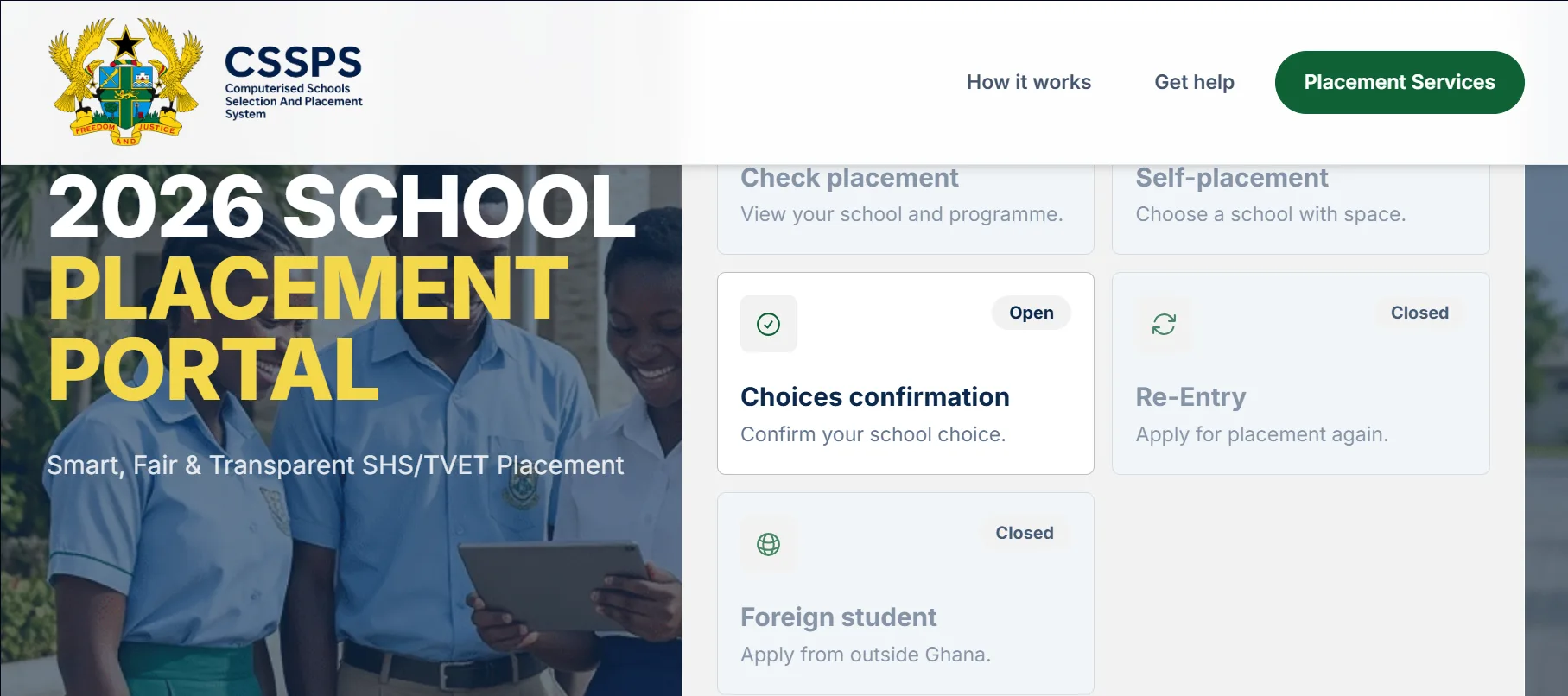
Candidates who selected TVET institutions should use the applicable CSSPS placement platform when placement results are released.
The general process involves accessing the placement system and providing the required candidate information.
Step 1: Access the Placement Portal
Candidates should use the official CSSPS placement platform when the placement portal is opened for the relevant admission cycle.
Step 2: Enter the Required Candidate Information
The candidate provides the required identification information, such as the BECE index number and examination year, in accordance with the instructions displayed on the portal.
Step 3: View the Placement Result
Once the candidate’s information has been verified, the placement result can be displayed.
The result should indicate the institution and programme to which the candidate has been placed.
Step 4: Print or Save the Placement Information
Candidates should retain a copy of their placement information because it may be required during the admission process.
The CSSPS placement guide provides additional information on checking placement and the steps that follow after the placement result is displayed.
What If a Candidate Is Not Placed in a TVET School?
Not being automatically placed in a selected institution does not necessarily mean that the candidate cannot obtain a place.
Where a qualified candidate is not matched with one of the selected schools, the CSSPS may direct the candidate to the self-placement process.
The candidate can then select from institutions with available vacancies.
The CSSPS Self-Placement Portal guide explains how candidates who are not automatically placed can select an available school and programme.
How to Perform TVET Self-Placement
Where the self-placement option is made available to an eligible candidate, the process generally involves selecting from available institutions and programmes.
The candidate may be required to provide information including:
- Region
- Residential preference
- School
- Programme of choice
The availability of a particular institution or programme depends on vacancies at the time of self-placement.
Candidates should therefore check the options displayed on the portal rather than assuming that every TVET institution will be available.
Can a Candidate Change a TVET Self-Placement Choice?
The self-placement system has historically allowed eligible candidates to change their selected school and programme before completing enrolment, subject to the rules applicable to the particular placement cycle.
The available options are determined by vacancies in the system.
Candidates should therefore carefully review the institution, programme and residential status before confirming their selection.
What Happens After TVET Placement?
Receiving a TVET placement is not necessarily the end of the admission process.
The candidate must proceed with the admission requirements of the assigned institution.
The next stages may include:
- Printing the placement documentation
- Obtaining the required admission documents
- Completing school admission procedures
- Preparing the required prospectus items
- Reporting to the institution on the designated date
Candidates should pay attention to communication from their assigned institution because schools can provide additional instructions regarding reporting and admission.
TVET Admission Documents Required After Placement
The exact documents can vary depending on the institution and admission arrangements.
Candidates should generally prepare documents such as:
- CSSPS placement information
- BECE results information
- Admission documentation
- Birth certificate or identification document where required
- Passport photographs
- Other documents requested by the institution
Candidates should not assume that every TVET institution requires exactly the same documents.
The institution’s admission instructions should be treated as the final guide.
TVET Admission and School Prospectus
After receiving placement, students also need to prepare the physical items required for school.
These can include:
- School uniforms
- Footwear
- Academic materials
- Toiletries
- Bedding for boarding students
- Cleaning materials
- Personal effects
- Programme-specific materials
The SHS/TVET school prospectus provides a useful reference for the types of items that have traditionally been required for students entering participating institutions.
Boarding students generally have additional residential requirements compared with day students.
TVET Boarding and Day Admission
The admission requirements can differ depending on whether a candidate is admitted as a boarder or day student.
TVET Boarding Students
Boarding students may need items such as:
- Bedding
- Suitcase or trunk
- Toiletries
- Personal effects
- Approved clothing
- Footwear
- Cleaning materials
TVET Day Students
Day students generally have fewer residential requirements because they do not live on campus.
They may instead require:
- School uniform
- Footwear
- School bag
- Academic materials
- Personal-care items
- Cleaning materials
Parents should confirm the specific requirements of the assigned institution before purchasing school-specific items.
TVET Admission and the Ghana SHS/TVET Admission Portal
Candidates should distinguish between CSSPS placement and the subsequent admission process.
Placement determines the school and programme assigned to the candidate, while admission involves completing the requirements necessary to enrol at the assigned institution.
The Ghana SHS/TVET Admission Student Portal provides information about the digital admission process for candidates following placement.
Where the applicable admission platform supports the candidate’s placement and institution, students should follow the instructions provided for their admission cycle.
TVET Programmes in Ghana
TVET encompasses a broad range of practical and technical disciplines.
Depending on the institution, students may find programmes related to areas such as:
- Engineering
- Construction
- Electrical installation
- Mechanical studies
- Automotive technology
- Information and communication technology
- Hospitality
- Fashion and textiles
- Agriculture
- Business
- Applied sciences
- Building technology
- Woodwork
- Metalwork
- Catering
- Other technical and vocational fields
The exact programme names and availability differ between institutions.
Candidates should therefore select from the programmes actually available during the official school selection exercise.
Why Students Should Consider TVET Education
TVET education provides students with opportunities to develop practical and technical competencies that can be useful in employment and entrepreneurship.
A student who completes a technical or vocational programme can potentially pursue further education, enter employment or develop a business around acquired skills.
TVET should therefore not be regarded simply as an alternative for students who cannot pursue academic programmes.
It is a distinct educational pathway with its own technical, practical and professional opportunities.
How Parents Can Help With TVET School Selection
Parents and guardians play an important role in helping candidates make informed decisions.
They should encourage students to consider:
- Personal interests
- Academic strengths
- Career ambitions
- Programme requirements
- School location
- Residential preference
- Available facilities
- Future educational opportunities
Parents should also avoid forcing students into programmes solely because of perceived prestige.
A well-selected TVET programme can provide a strong foundation for a student’s future career.
Common Mistakes to Avoid During TVET Admission
Choosing a Programme Without Understanding It
Students should understand what a programme involves before selecting it.
Ignoring Residential Status
Candidates should pay attention to whether they are selecting boarding or day placement.
Choosing Only Highly Competitive Schools
A candidate who selects only highly competitive institutions may increase the possibility of missing out on the preferred choices.
Ignoring Available Vacancies During Self-Placement
Self-placement depends on available vacancies. Candidates should choose from the options actually displayed.
Paying Unofficial Agents for Placement
Candidates and parents should be extremely cautious about individuals claiming that they can influence CSSPS placement for payment.
The placement process is intended to be transparent and candidates should use the official channels.
GESHub has previously reported warnings concerning individuals who demand money in exchange for influencing placement.
Frequently Asked Questions
How can a student apply for TVET admission in Ghana?
For BECE candidates entering second-cycle TVET institutions through the national placement process, the process begins with the applicable school and programme selection exercise. Eligible candidates then participate in the CSSPS placement process.
How do I check my TVET placement?
Candidates should check their placement through the applicable CSSPS placement platform when the results are released. The placement result should show the institution and programme assigned to the candidate.
Can BECE candidates choose TVET schools?
Yes. The CSSPS school selection process provides for candidates seeking placement into technical and vocational institutions and programmes.
Can a candidate be placed in a TVET school through CSSPS?
Yes. TVET institutions form part of the second-cycle institutions considered under the placement system.
What happens if a candidate is not placed in a selected TVET school?
Where the candidate qualifies and is not matched with a selected institution, the self-placement process may become available, allowing the candidate to select from institutions with available vacancies.
Can TVET candidates perform self-placement?
Where self-placement is activated for the relevant placement cycle, eligible candidates who are not automatically placed can select an available institution and programme through the self-placement system.
Do TVET students need a prospectus?
Students entering TVET institutions can have school and programme requirements, including academic materials, clothing, personal effects and, where applicable, residential items.
Are TVET admission requirements the same for every school?
Not necessarily. General requirements may be similar, but institutions and programmes can have additional requirements.
Is TVET a good option after BECE?
TVET can be an excellent pathway for students interested in practical, technical and vocational careers. The suitability of a particular programme depends on the student’s interests, abilities and career objectives.
Final Word on Ghana TVET Admission 2026/2027
The Ghana TVET admission process provides BECE candidates with an opportunity to pursue technical and vocational education through participating institutions and programmes.
The process begins with careful school and programme selection, followed by placement through the applicable CSSPS process. Candidates should understand that placement depends on several factors, including academic performance, programme choice, school choice, residential preference and available vacancies.
After placement, candidates should complete the applicable admission requirements, prepare the required documents and obtain the necessary school items.
Candidates who are not automatically matched may, where eligible and where the self-placement process is activated, use the CSSPS self-placement system to select from available TVET institutions and programmes.
The most important consideration throughout the process is informed decision-making. Students should select TVET programmes based on their interests, abilities and career goals rather than simply choosing a school because it is popular.
As the 2026/2027 admission cycle progresses, candidates should rely on the applicable official placement and admission instructions and avoid unofficial individuals claiming to guarantee TVET placement.
For related information, candidates can also review the SHS/SHTS/TVET placement guide, the CSSPS Self-Placement guide and the SHS/TVET prospectus information.
Published By: Justice Donkoh | GESHub.org