

The 2026 national budget has sparked significant conversation within Ghana’s education sector, particularly regarding funding priorities and the expectations of graduate teachers awaiting recruitment. Insights shared by Kofi Asare, Executive Director of Africa Education Watch (EduWatch), shed light on what the numbers really mean—and what teacher trainees and graduates should anticipate.
A Modest Increase in Education Funding
According to EduWatch, the education sector has been allocated GHS 43.2 billion for 2026, representing a 2.6% increase over the 2025 allocation of GHS 42.1 billion. This marks the smallest year-on-year budget growth for education since 2021.
Even more concerning is the allocation as a share of GDP. The 2026 figure accounts for 2.7% of GDP, falling short of UNESCO’s recommended 4%–6% guideline. It is also the lowest in over a decade, and notably below Ghana’s own 2025 level of 3.1%.
Major Investment in Basic Education Infrastructure
Despite the modest overall growth, the 2026 budget dedicates substantial resources to basic education infrastructure.
The government has earmarked GHS 2 billion for the construction of 200 new KG, Primary, and JHS blocks, in addition to the 261 facilities already underway under the District Assemblies Common Fund (DACF).
EduWatch notes that this represents over 20% of the GETFund allocation, demonstrating a clear emphasis on improving learning environments and promoting equitable access across communities.
Free SHS Receives Its Highest Funding Ever
Another key highlight is the allocation of GHS 4.2 billion to the Free SHS programme—the largest in its history. This represents a 20% increase over the 2025 allocation of GHS 3.5 billion.
With this investment, more than 1.5 million students are expected to benefit from Free SHS and TVET in 2026. The government’s commitment suggests continued prioritization of senior high and technical–vocational education accessibility.
Support for Teachers: Housing and Retention
The 2026 budget also announces the construction of 400 four-unit teacher quarters, aimed at housing 1,600 teachers in deprived communities. EduWatch describes this as a welcome initiative, emphasizing its importance for teacher retention and overall learning outcomes in rural areas.
On Teacher Recruitment: What Should Graduates Expect?
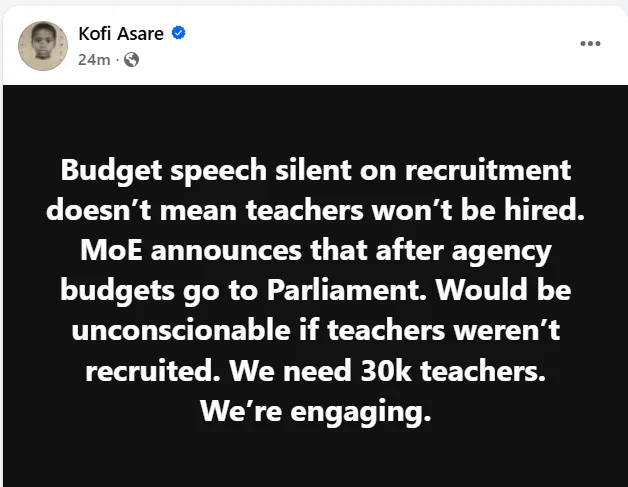
One area that raised concerns among teacher trainees and graduates is the absence of explicit mention of teacher recruitment in the budget speech.
However, EduWatch stresses that this is not unusual. The Ministry of Education typically announces recruitment plans after agency budgets and ceilings are finalized in Parliament.
Kofi Asare describes it as “unconscionable” for government not to recruit teachers—especially when the system urgently needs around 30,000 new teachers. EduWatch confirms that engagements are ongoing to push for adequate recruitment in 2026.
Conclusion
While the 2026 education budget shows mixed signals—strong infrastructure commitments but modest overall growth—there is still reasonable assurance that GES graduate recruitment will take place once parliamentary processes are complete.
Teacher trainees and graduates are therefore encouraged to stay calm, stay updated, and await the official Ministry of Education announcement, which traditionally follows the budget approval process.
For all updates on 2026 GES graduate recruitment, keep an eye on this space!
Published By: Justice Donkoh | GESHub.org