
On November 14, 2023, the Government of Ghana, in collaboration with the Fair Wages and Salaries Commission (FWSC), Ministry of Employment and Labour Relations (MELR), Ministry of Finance (MoF), and Organized Labour, reached a significant agreement on the 2024 base pay adjustment for Public sector workers in the country.
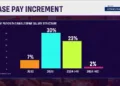
The terms of the agreement include a 23% across-the-board increase in the Base Pay on the Single Spine Salary Structure (SSSS) from January 2024 to June 2024, followed by a mid-year adjustment of 25% from July 2024 to December 2024.
In light of this announcement, many are curious about what Base Pay Salary entails and how to calculate percentage increments on it. This blog post aims to provide a comprehensive understanding of Base Pay Salary and guide readers through the calculation process using the newly agreed-upon terms.
Understanding Base Pay Salary
Base Pay Salary, often referred to simply as Base Salary, is the fixed amount of compensation an employee receives before any additional bonuses, benefits, or allowances.
It forms the foundation of an employee’s total remuneration and is typically established based on factors such as the individual’s skills, experience, and the overall pay structure of the organization.
Calculation of Base Pay Salary
In the context of the public sector in Ghana, the Single Spine Salary Structure (SSSS) is used to determine the Base Pay. The SSSS is a pay policy that aligns salaries across various public sector organizations, ensuring equity and transparency.
Calculating Percentage Increment
To calculate the percentage increment on the Base Pay Salary, you can use the following formula:
- New Base Pay Salary = Base Pay Salary + (Base Pay Salary × Percentage Increment)
Illustrative Example
Let us consider a monthly Base Pay Salary of 3,500 Ghana cedis. Using the terms of the 2024 agreement:
January 2024 to June 2024 (23% increase)
- New Base Pay Salary = 3,500 + (3,500 × 0.23)
- New Base Pay Salary = 3,500 + 805
- New Base Pay Salary = 4,305
July 2024 to December 2024 (2% increase)
- New Base Pay Salary = 4,305 + (4,305 × 0.02)
- New Base Pay Salary = 4,305 + 86.1
- New Base Pay Salary = 4,391.1
Conclusion
Understanding Base Pay Salary is crucial for employees to grasp the foundation of their compensation structure. As demonstrated with the example, calculating percentage increments on Base Pay Salary is a straightforward process.
The recent agreement in Ghana’s public sector serves as a practical illustration of how such calculations impact real-world scenarios, ensuring transparency and fair compensation for the workforce.
Learn more about the comprehensive guide to understanding Base Pay Salary in Ghana on this page.
Source: GESHub.org